Protecting the Power Grid
Through Accessibility Research
Digital Accessibility & Inclusive Research Case Study | Energy & Utilities Industry

Overview
Onward Accessibility helped a Global Energy company uncover user access needs, improve control room safety, and advance its accessibility journey through onsite user research.
The Challenge
Understanding accessibility without a known defect or disability.
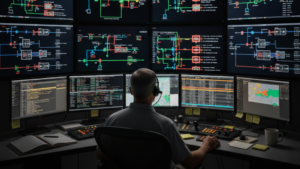 A power grid control room is a remarkably complex place. Each operator sits before a workstation with ten or more visible monitors, displaying a vast array of applications connected to high-voltage transmission lines, substations, transformers, breakers, and live field work. Every screen matters. Every signal competes for attention. And every decision has consequences that extend far beyond the room.
Our client, a Global Energy company, develops the grid operations software used in these rooms, and they’re a leader in their field. But when accessibility questions began to appear in their requests for information, the organization didn’t know where to start. There were no disclosed disabilities among operators. And without a full understanding of operator profiles or access needs, a traditional audit felt premature.
What the client did know was this: there’s no room for error in energy work. In this field, small mistakes can cascade into serious harm. The global enterprise needed to understand how their software’s accessibility could impact user performance — and what could be done to ensure it met the highest standards so their clients could do the same. More than learn about their current operators, they set out to study the profiles and needs of potential users. And it wasn’t just a matter of accommodation; it was a prerequisite for safety.
The Solution
Conducting inclusive research in a place few ever enter.
 Energy management software isn’t an e-commerce site. The software is used in control rooms, and that’s where it needed to be assessed. Recognizing this, Onward Accessibility brought in an experienced specialist from our network to conduct foundational, in-person research. This meant navigating high-security protocols and gaining clearance to visit a typically undisclosed location. But being physically present proved essential.
Before ever embarking on the trip, we studied the industry and technology extensively in preparation. Then, we combined in-depth interviews with on-site observation. Our experienced researcher witnessed firsthand how operators manage long shifts, constant interruptions, dense visual information, and hundreds of daily alarms. We found that most operators don’t identify as disabled, but they do have a wide range of access needs.
Our team developed a comprehensive report, detailing these critical needs, accessibility risks, and strategic guidance for advancing their accessibility journey. Finally, we offered stakeholders a live consultation session to walk through our findings and their implications. With a deeper understanding of its potential users and a clear path forward, the client was equipped to respond to customer expectations, reduce legal exposure, and uphold the safety standards required of power grid operations.

This is a very clear case of digital accessibility and inclusive design making things better for everyone.
Greg Weinstein, PhD, CPACC
Inclusive Research Lead
By The Numbers
The following figures capture the scope, rigor, and importance of the software accessibility research conducted:
6
areas of non-apparent disability risk identified
8
in-depth Interviews conducted
10+
monitors per workstation observed
20
distinct alarm color combinations analyzed
By the Access Needs
Our research identified potential age-related challenges, situational needs, and non-apparent disabilities — such as ADHD, dyslexia, and color blindness in users. These findings called for:
-
Considering Cognitive Load Limitations
Operators had to process hundreds of data points across systems, which required clearer prioritization and reduced visual clutter for people of different cognitive abilities.
-
Reducing Reliance on Memory
Critical system knowledge often lived in operators’ heads or handwritten notes. Storing that information in the software would reduce the need to rely on recall under stress.
-
Improving Color Use and Choice
Overlapping and low-contrast color use made urgency hard to distinguish without text or symbols to reinforce meaning, even for operators without color blindness.
-
Supporting Attention and Task Switching
Frequent distractions and task switching increased the risk of error, making it critical for the software to preserve context across tasks.
-
Preventing Workflow Lockups
During grid actions, system freezes disrupted work and could disproportionately impact users with disabilities, making change essential to efficiency.
-
Elevating User Interfaces
Long hours and gradual changes in eyesight, hearing, and stamina demanded user interfaces that remain clear, consistent, and easy to interpret over time.
Flexible Options for Your Journey
Digital accessibility is complex, but getting started doesn’t have to be.